

Author: Rimi Kbar
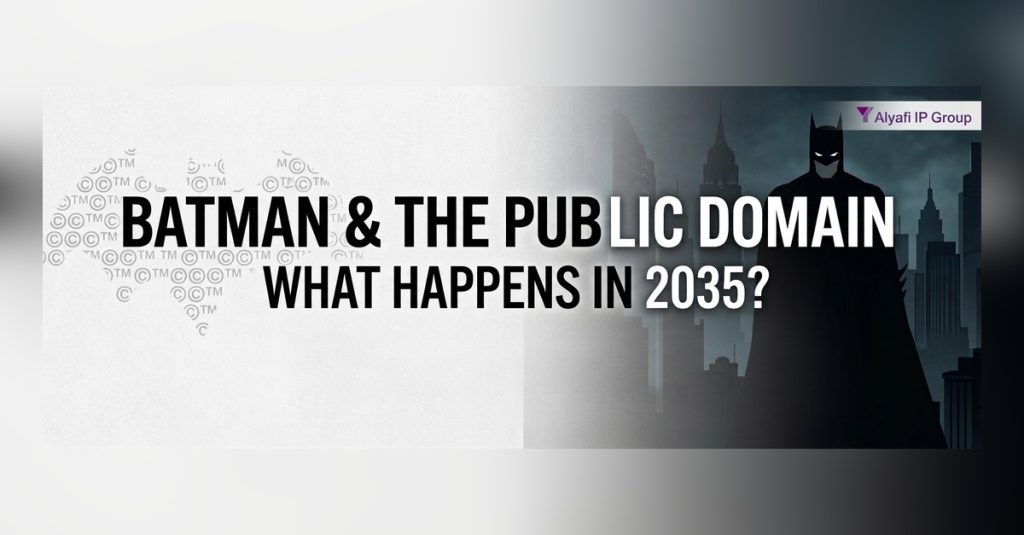
Batman and the Public Domain: What Happens in 2035?
Batman’s earliest appearance is expected to enter the U.S. public domain on 1 January 2035. But does that mean anyone will be free to make a Batman film, comic or game? Not quite.
Batman has survived the Joker, Bane, the Riddler and nearly nine decades of reinvention. His next challenge, however, is a legal one: copyright expiry.
Batman first appeared in Detective Comics #27 in 1939. Under current U.S. copyright law, the original 1939 material is expected to enter the public domain on 1 January 2035. Duke Law’s Center for the Study of the Public Domain also identifies 2035 as the year in which the initial version of Batman is expected to enter the U.S. public domain.
At first glance, that sounds dramatic. It might suggest that, from 2035 onwards, Batman will simply become free for anyone to use.
The reality is considerably more complicated.
Which Batman enters the public domain in 2035?
This is where copyright law becomes particularly interesting.
Characters that have existed for decades rarely remain static. They evolve through new stories, designs, characteristics, relationships and creative interpretations. As a result, copyright protection can effectively exist in layers.
When the copyright in the original 1939 Batman material expires, creators may be able to use the version of Batman — and the protectable creative elements associated with him — that appeared in those early works.
But the Batman audiences recognize today is the product of decades of additional creativity.
Later costume designs, characters, storylines, gadgets, vehicles, visual elements and other developments may remain protected by separate copyrights long after the earliest Batman material has entered the public domain. Copyright protection for a derivative work extends to the new original material added to it, rather than simply disappearing when protection for an earlier underlying work expires.
The distinction is therefore important: the availability of the original 1939 material does not automatically make every later version of Batman available for unrestricted use.
Batman did not become the Batman we know today in a single comic
The development of the character provides a particularly good illustration of how these layers can arise.
Batman first appeared in Detective Comics #27 in 1939, but DC’s own history notes that his origin story was not revealed until Detective Comics #33. Robin arrived in Detective Comics #38 in 1940. The Joker and Catwoman appeared in Batman #1 in 1940, while Gotham City was not named until Batman #4 in 1941.
These later additions matter.
A creator could not simply reproduce Batman as he appears in a recent film, video game or modern comic and rely on the fact that the original character had entered the public domain.
The relevant question would instead be:
Did the element being used already exist in the public-domain version of Batman, or was it introduced in a later work that remains protected?
That distinction may apply to visual characteristics, supporting characters, settings, story elements, equipment and other distinctive aspects of the Batman universe.
The U.S. Copyright Office similarly recognises that fictional characters may receive copyright protection where their particular literary or visual attributes are sufficiently developed and expressed.
Does this mean anyone can make a Batman movie in 2035?
Potentially, someone could create a new work based on material that has genuinely entered the public domain.
But that does not mean that every element associated with Batman would suddenly become available.
A creator producing a new comic, film, game or other work would need to identify which elements originated in the 1939 public-domain material and which came from later copyrighted works.
This is one reason the public-domain status of long-running fictional characters can be more complicated than the public-domain status of a single novel, painting or photograph.
It is not simply a question of whether Batman is protected.
It is a question of which Batman.
Copyright may expire, but trademarks are different
Copyright is also only one part of the picture.
BATMAN, together with related names, logos and other branding, may also be protected through trademark law.
Unlike copyright, which generally lasts for a defined period, trademark registrations can potentially continue indefinitely where the mark remains in use and the required maintenance filings are made. The USPTO expressly notes that a U.S. federal trademark registration can last indefinitely if these requirements continue to be satisfied.
This does not mean that trademark law can simply be used to recreate expired copyright protection.
The U.S. Supreme Court has cautioned against extending trademark law into areas properly governed by copyright, including where copyright protection has expired.
Trademark law nevertheless serves a different purpose: protecting source identification and helping prevent consumer confusion.
That distinction can become particularly important in areas such as:
- titles and branding;
- logos and packaging;
- advertising and promotion;
- merchandise; and
- representations suggesting that a product is officially licensed, authorized, sponsored or affiliated with the existing Batman brand.
Accordingly, the fact that particular Batman material has entered the public domain would not automatically give a creator the right to market a new product in a manner that misleadingly suggests that it comes from, or has been authorized by, the existing rights holder.
The question is therefore not simply:
“Can I use Batman?”
It is more accurately:
Which Batman elements are in the public domain, which elements remain protected by copyright, and how can public-domain material be used without infringing other IP rights or creating consumer confusion?
Is Batman public domain everywhere in 2035?
No — and this point is particularly important for international businesses and creators.
Copyright is territorial.
Copyright terms and rules differ between jurisdictions, and a work entering the public domain in the United States does not necessarily mean that the same work becomes free to use everywhere else on the same date.
A comic, film, video game or other project involving public-domain material may therefore be lawful to distribute in one country while relevant rights remain protected in another.
For creators planning international releases, the analysis should therefore consider both:
what material is being used; and where the resulting work will be published, sold or distributed.
What Batman teaches us about IP protection
Batman provides a useful example of why valuable fictional characters are rarely protected by only one intellectual property right.
Copyright protects creative expression, but that protection eventually expires.
Trademark law protects indicators of commercial origin and can potentially continue for as long as the relevant rights remain valid and in use.
Meanwhile, new versions of a longstanding character can generate additional layers of copyright protection, and different jurisdictions may apply different rules to when those rights expire.
The entry of a famous character into the public domain is therefore rarely an all-or-nothing event.
In 2035, part of the Batcave door may finally open.
But anyone hoping to walk straight in would still be well advised to check which IP rights remain on the other side.
Frequently Asked Questions
Will Batman become public domain in 2035?
Under current U.S. copyright law, the original Batman material first published in 1939 is expected to enter the U.S. public domain on 1 January 2035. This concerns the earliest version of the character, not every subsequent version or element associated with Batman.
Will all versions of Batman become public domain?
No. Later creative additions can remain separately protected. Modern costume designs, stories, characters and other elements should therefore be analyzed independently.
Does DC lose all rights to Batman in 2035?
No. The expiry of copyright in early material does not automatically terminate copyrights in later material or separate trademark rights.
Can trademarks stop people using public-domain Batman material?
Trademark law cannot simply replace an expired copyright. However, trademark and unfair-competition issues can still arise, particularly where branding or marketing is likely to create confusion regarding source, sponsorship, affiliation or authorization.
Does Batman enter the public domain worldwide in 2035?
Not necessarily. Copyright protection is territorial, and the applicable term needs to be considered separately in each country where a work will be distributed or commercialized.